Artificial Intelligence
Which GPU for Your Agentic AI Model Size: DGX Spark vs. 4x RTX PRO 6000 vs. DGX Station
July 30, 2026
10 min read

Agentic AI changes GPU sizing because agents do more than hold model weights and one conversation. Tool calls, retrieved documents, long reasoning chains, and concurrent sessions all add memory pressure through context and KV cache.
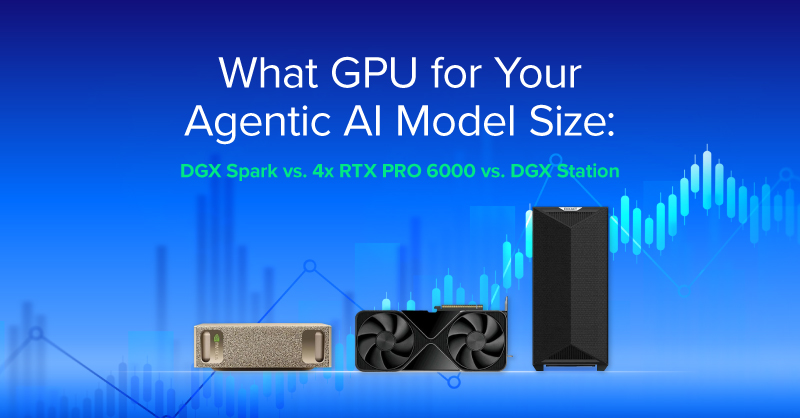
The most popular agentic AI hardware today include the NVIDIA DGX Spark GB10, a 4x NVIDIA RTX PRO 6000 Blackwell Max-Q configuration, and an NVIDIA DGX Station GB300. At Exxact we wanted to make a hardware guide for your agentic AI based on model size, context length, and concurrency.
Three things inflate memory requirements for agentic AI beyond what the base LLM size suggests. This includes:
The result is that context length and concurrency can consume as much memory as the model itself, sometimes more. Sizing hardware around parameter count alone is the most common mistake teams make when moving an agent from a demo to production.
Model weight memory is straightforward: parameter count multiplied by bytes per parameter depending on the quantization. BF16/FP16 uses 2 bytes per parameter, 8-bit quantization (INT8/FP8) uses roughly 1 byte, and 4-bit quantization (INT4, GGUF, AWQ) uses roughly 0.5 bytes. Add 10 to 20 percent on top of the weight figure for activations and framework overhead before the model even starts serving a request.
| Parameter band in Billion | FP16/BF16 (weights only) | 8-bit | 4-bit | Typical agentic role |
|---|---|---|---|---|
| 7B–14B | 14–28 GB | 7–14 GB | 3.5–7 GB | Routers, tool-call classifiers, guardrail/validator models, fast sub-agents |
| 30B–40B | 60–80 GB | 30–40 GB | 15–20 GB | Capable single-purpose agents: code generation, retrieval synthesis, structured extraction |
| 70B–80B | 140–160 GB | 70–80 GB | 35–40 GB | General-purpose reasoning agents, mid-complexity task orchestrators |
| 100B–200B | 200–400 GB | 100–200 GB | 50–100 GB | Primary planning/reasoning models, long-form synthesis across many tool outputs |
| 400B+ | 800 GB+ | 400 GB+ | 200 GB+ | Frontier-class reasoning as a single model, or an orchestrator standing in for what would otherwise be an ensemble of smaller agents |
That table only covers weights. Context length adds a second, separately scaling cost: the KV (key-value) cache, which stores the attention keys and values for every token already processed so the model doesn't recompute them on each new token.
Depending on implementation and KV precision, a 70B-class model at 128,000-token context can require tens of gigabytes of KV cache for a single session. One commonly cited estimate for Llama 3.1 70B is roughly 42GB at 128K context. Every concurrent session multiplies that cache cost again, which is why model size alone doesn’t tell the full memory requirement story.
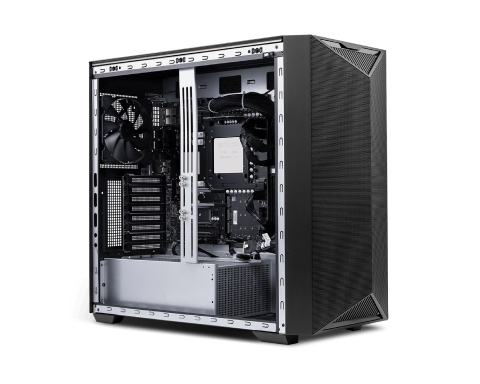
Exxact Valence 4x Max-Q Workstation, NVIDIA DGX Spark, and NVIDIA DGX Station GB300 deliver data‑center‑class AI performance to run bleeding-edge models and agentic AI locally. Accelerate innovation, scale experiments faster, and turn ideas into impact right at your desk.
Get a Quote TodayThe DGX Spark pairs a GB10 Grace Blackwell Superchip with 128GB of unified CPU-GPU memory and roughly 273GB/s of LPDDR5x bandwidth. It is best used as a development and validation system before scaling to a larger workstation, DGX Station, or data center deployment.
A 4x RTX PRO 6000 Blackwell workstation provides four independent 96GB GDDR7 ECC GPUs, each with roughly 1.6–1.8TB/s of memory bandwidth. Because RTX PRO 6000 Blackwell does not support NVLink, multi-GPU communication runs over PCIe, making this configuration best suited to one model per GPU rather than one large model spread across all four cards.
The DGX Station is built around the GB300 Grace Blackwell Ultra Superchip and a 748GB coherent unified memory pool: 252GB of HBM3e at 7.1TB/s plus 496GB of LPDDR5X at 396GB/s. That unified memory design makes it a strong fit for large models, long context windows, and heavier agent workflows.
| DGX Spark | 4x RTX PRO 6000 Blackwell | DGX Station | |
|---|---|---|---|
| Memory | 128GB unified (CPU+GPU) | 96GB per GPU, 384GB total, not pooled | 748GB coherent unified (252GB HBM3e + 496GB LPDDR5X) |
| Bandwidth | ~273 GB/s (shared) | ~1.6–1.8 TB/s per card | 7.1 TB/s (HBM3e side), 900 GB/s CPU-GPU interconnect |
| Comfortable single-model ceiling | 7B–40B | 70B–80B per card at 8-bit or lower | 100B–400B+ with quantization |
| Best agent pattern | Prototyping, 1–3 lightweight specialists | Multiple parallel agents, one model per GPU | One large model as its own orchestrator, long context |
| Multi-model approach | Sequential/rotational specialists, or dual-Spark clustering | Independent models per card, occasional 2-GPU tensor split | Single large context-rich model, or partitioned for isolated workloads where supported |
| Where it fits in a workflow | Design and test agent architecture before scaling | Production serving of a multi-agent stack | Serving or fine-tuning the largest single reasoning model in the pipeline |
Memory capacity determines whether a model loads. Memory bandwidth determines how quickly it generates tokens once loaded. The best platform depends on whether the workload needs several independent models, one very large model, or a development environment for testing the architecture.
Yes, with quantization. At 4-bit, a 70B model can fit comfortably with headroom for a larger context window. At 8-bit, it can fit with a smaller context window. At FP16, the weights alone require roughly 140GB, which exceeds a single 96GB RTX PRO 6000.
Yes, for models above roughly the 30B–40B range. Smaller models can run without aggressive quantization, but larger models need quantization to leave room for context, KV cache, and framework overhead. The 128GB pool is real capacity, but its shared bandwidth means heavily loaded models can slow down faster than the same models on discrete GPUs.
No. Once a model and its context comfortably fit, bandwidth and the number of concurrent sessions a platform can serve matter more than any remaining headroom. A model that barely fits with no room for KV cache growth will bottleneck on context length well before it bottlenecks on raw compute.
The request either fails with an out-of-memory error or the serving framework truncates earlier context to make room, both of which are disruptive mid-task for an agent that depends on its own history. Sizing for the expected maximum context length and concurrent session count up front, not just the model's parameter count, avoids this failure mode in production.
The right platform depends on model size, context length, and concurrency. Parallel specialist agents point toward multiple RTX PRO 6000 GPUs. A single large reasoning model with long context points toward DGX Station. Early architecture testing points toward DGX Spark.
Exxact offers configurable platform for your Agentic AI workload requirements, helping teams choose the right memory, bandwidth, and GPU count before hardware is ordered.
Exxact Valence 4x Max-Q Workstation, NVIDIA DGX Spark, and NVIDIA DGX Station GB300 deliver data‑center‑class AI performance to run bleeding-edge models and agentic AI locally. Accelerate innovation, scale experiments faster, and turn ideas into impact right at your desk.
Get a Quote TodayAgentic AI changes GPU sizing because agents do more than hold model weights and one conversation. Tool calls, retrieved documents, long reasoning chains, and concurrent sessions all add memory pressure through context and KV cache.
The most popular agentic AI hardware today include the NVIDIA DGX Spark GB10, a 4x NVIDIA RTX PRO 6000 Blackwell Max-Q configuration, and an NVIDIA DGX Station GB300. At Exxact we wanted to make a hardware guide for your agentic AI based on model size, context length, and concurrency.
Three things inflate memory requirements for agentic AI beyond what the base LLM size suggests. This includes:
The result is that context length and concurrency can consume as much memory as the model itself, sometimes more. Sizing hardware around parameter count alone is the most common mistake teams make when moving an agent from a demo to production.
Model weight memory is straightforward: parameter count multiplied by bytes per parameter depending on the quantization. BF16/FP16 uses 2 bytes per parameter, 8-bit quantization (INT8/FP8) uses roughly 1 byte, and 4-bit quantization (INT4, GGUF, AWQ) uses roughly 0.5 bytes. Add 10 to 20 percent on top of the weight figure for activations and framework overhead before the model even starts serving a request.
| Parameter band in Billion | FP16/BF16 (weights only) | 8-bit | 4-bit | Typical agentic role |
|---|---|---|---|---|
| 7B–14B | 14–28 GB | 7–14 GB | 3.5–7 GB | Routers, tool-call classifiers, guardrail/validator models, fast sub-agents |
| 30B–40B | 60–80 GB | 30–40 GB | 15–20 GB | Capable single-purpose agents: code generation, retrieval synthesis, structured extraction |
| 70B–80B | 140–160 GB | 70–80 GB | 35–40 GB | General-purpose reasoning agents, mid-complexity task orchestrators |
| 100B–200B | 200–400 GB | 100–200 GB | 50–100 GB | Primary planning/reasoning models, long-form synthesis across many tool outputs |
| 400B+ | 800 GB+ | 400 GB+ | 200 GB+ | Frontier-class reasoning as a single model, or an orchestrator standing in for what would otherwise be an ensemble of smaller agents |
That table only covers weights. Context length adds a second, separately scaling cost: the KV (key-value) cache, which stores the attention keys and values for every token already processed so the model doesn't recompute them on each new token.
Depending on implementation and KV precision, a 70B-class model at 128,000-token context can require tens of gigabytes of KV cache for a single session. One commonly cited estimate for Llama 3.1 70B is roughly 42GB at 128K context. Every concurrent session multiplies that cache cost again, which is why model size alone doesn’t tell the full memory requirement story.
Exxact Valence 4x Max-Q Workstation, NVIDIA DGX Spark, and NVIDIA DGX Station GB300 deliver data‑center‑class AI performance to run bleeding-edge models and agentic AI locally. Accelerate innovation, scale experiments faster, and turn ideas into impact right at your desk.
Get a Quote TodayThe DGX Spark pairs a GB10 Grace Blackwell Superchip with 128GB of unified CPU-GPU memory and roughly 273GB/s of LPDDR5x bandwidth. It is best used as a development and validation system before scaling to a larger workstation, DGX Station, or data center deployment.
A 4x RTX PRO 6000 Blackwell workstation provides four independent 96GB GDDR7 ECC GPUs, each with roughly 1.6–1.8TB/s of memory bandwidth. Because RTX PRO 6000 Blackwell does not support NVLink, multi-GPU communication runs over PCIe, making this configuration best suited to one model per GPU rather than one large model spread across all four cards.
The DGX Station is built around the GB300 Grace Blackwell Ultra Superchip and a 748GB coherent unified memory pool: 252GB of HBM3e at 7.1TB/s plus 496GB of LPDDR5X at 396GB/s. That unified memory design makes it a strong fit for large models, long context windows, and heavier agent workflows.
| DGX Spark | 4x RTX PRO 6000 Blackwell | DGX Station | |
|---|---|---|---|
| Memory | 128GB unified (CPU+GPU) | 96GB per GPU, 384GB total, not pooled | 748GB coherent unified (252GB HBM3e + 496GB LPDDR5X) |
| Bandwidth | ~273 GB/s (shared) | ~1.6–1.8 TB/s per card | 7.1 TB/s (HBM3e side), 900 GB/s CPU-GPU interconnect |
| Comfortable single-model ceiling | 7B–40B | 70B–80B per card at 8-bit or lower | 100B–400B+ with quantization |
| Best agent pattern | Prototyping, 1–3 lightweight specialists | Multiple parallel agents, one model per GPU | One large model as its own orchestrator, long context |
| Multi-model approach | Sequential/rotational specialists, or dual-Spark clustering | Independent models per card, occasional 2-GPU tensor split | Single large context-rich model, or partitioned for isolated workloads where supported |
| Where it fits in a workflow | Design and test agent architecture before scaling | Production serving of a multi-agent stack | Serving or fine-tuning the largest single reasoning model in the pipeline |
Memory capacity determines whether a model loads. Memory bandwidth determines how quickly it generates tokens once loaded. The best platform depends on whether the workload needs several independent models, one very large model, or a development environment for testing the architecture.
Yes, with quantization. At 4-bit, a 70B model can fit comfortably with headroom for a larger context window. At 8-bit, it can fit with a smaller context window. At FP16, the weights alone require roughly 140GB, which exceeds a single 96GB RTX PRO 6000.
Yes, for models above roughly the 30B–40B range. Smaller models can run without aggressive quantization, but larger models need quantization to leave room for context, KV cache, and framework overhead. The 128GB pool is real capacity, but its shared bandwidth means heavily loaded models can slow down faster than the same models on discrete GPUs.
No. Once a model and its context comfortably fit, bandwidth and the number of concurrent sessions a platform can serve matter more than any remaining headroom. A model that barely fits with no room for KV cache growth will bottleneck on context length well before it bottlenecks on raw compute.
The request either fails with an out-of-memory error or the serving framework truncates earlier context to make room, both of which are disruptive mid-task for an agent that depends on its own history. Sizing for the expected maximum context length and concurrent session count up front, not just the model's parameter count, avoids this failure mode in production.
The right platform depends on model size, context length, and concurrency. Parallel specialist agents point toward multiple RTX PRO 6000 GPUs. A single large reasoning model with long context points toward DGX Station. Early architecture testing points toward DGX Spark.
Exxact offers configurable platform for your Agentic AI workload requirements, helping teams choose the right memory, bandwidth, and GPU count before hardware is ordered.
Exxact Valence 4x Max-Q Workstation, NVIDIA DGX Spark, and NVIDIA DGX Station GB300 deliver data‑center‑class AI performance to run bleeding-edge models and agentic AI locally. Accelerate innovation, scale experiments faster, and turn ideas into impact right at your desk.
Get a Quote Today